
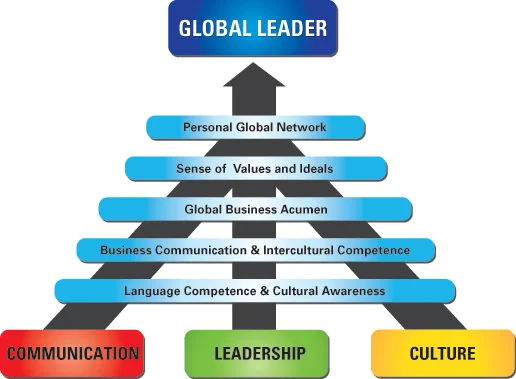
As organisations and institutions increasingly operate across borders, "global leadership" is often assumed to follow from technical expertise, language ability or overseas experience. Comparative research suggests this assumption does not hold: what distinguishes effective global leaders is a set of psychological and behavioural capabilities distinct from and not automatically produced by international exposure alone. This brief outlines what the evidence indicates those capabilities are, and their implications for how global leadership should be taught.
Context
Today's international environment is frequently characterised by volatility, uncertainty, complexity and ambiguity, requiring leaders who can collaborate across cultural boundaries to address problems that are increasingly interconnected across borders. This has driven substantial growth in global leadership education, yet international comparative research indicates that the capabilities required go beyond what conventional international management or language training typically provides.
Key Findings
-
1
Global leadership performance depends on capabilities beyond technical or linguistic skill.
Comparative research across institutions indicates that achieving effective performance as a global leader requires capabilities beyond technical expertise in international management, language proficiency, or overseas experience alone.
-
2
Cross-cultural consensus-building and experiential learning are central capabilities.
What matters more, according to this research, is the ability to design pathways toward cross-cultural consensus and to apply experiential learning to future situations psychological and behavioural capacities rather than purely technical or linguistic knowledge.
-
3
Cultural intelligence is distinct from cultural awareness, and is developable.
Cultural intelligence the ability to adapt and apply understanding across culturally diverse situations, as distinct from simply being aware that differences exist is not an innate trait. Research indicates it can be developed intentionally through targeted training, with active-listening-based approaches associated with measurable gains in cultural competence.
-
4
Cultural misalignment is increasingly treated as an operational risk, not a soft skill.
* Contemporary organisational practice is shifting toward treating cross-cultural competence as a continuous, measurable capability rather than a one-off training event, reflecting recognition that cultural misalignment among leaders carries direct operational and governance consequences, not only interpersonal ones.
Institutional Implications
For an institution delivering international leadership education, this evidence suggests programmes should treat cultural intelligence as a distinct, teachable competency rather than an assumed by-product of international exposure; should incorporate applied, experiential formats over classroom theory alone; and should build in ongoing rather than one-time cultural competence development, given that misalignment risk compounds over time.
Recommendation
Global leadership programmes should be structured around applied cross-cultural consensus-building and cultural intelligence development as explicit, assessed capabilities, rather than assuming these follow automatically from international exposure or subject-matter expertise.